Model report · YOLO26s
EleFind YOLO26s
A 9.95-million-parameter, single-class elephant detector fully fine-tuned for nadir aerial photography. Its launch evaluation uses held-out source photographs, metre-based point matching, altitude-aware box analysis, and a direct YOLO11s baseline comparison.
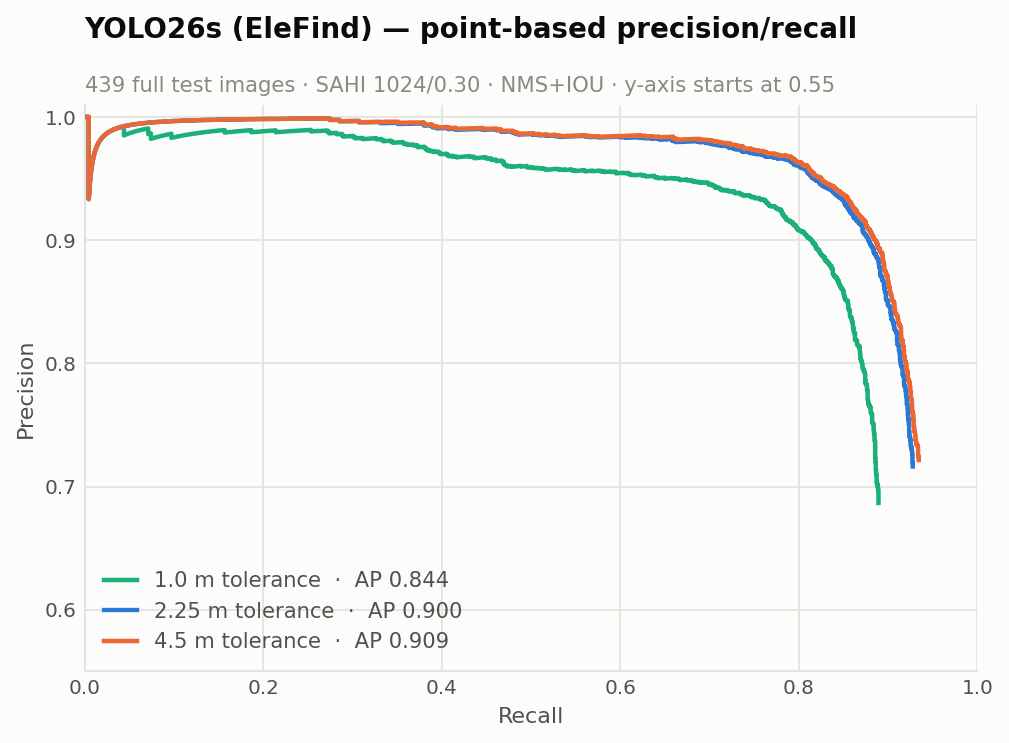
Point AP is the primary metric because the source dataset provides elephant centre points rather than measured ground-truth boxes. All headline test results use cross-tile NMS/IOU after tiled inference on held-out full-resolution photographs.
Evaluation context
How this model was measured
438 annotated source photos plus one negative image, held out from model training.
Centre-point annotations scored at 1.0 m, 2.25 m, and 4.5 m matching tolerances.
5,795 positive and 11,590 background tiles derived from 1,304 source photos.
A compact 19.5 MB model with all 902 layers transferred for full fine-tuning.
Operating configuration
- Required slice size
- 1024 × 1024 px
- Required overlap
- 0.30
- Inference confidence
- 0.30
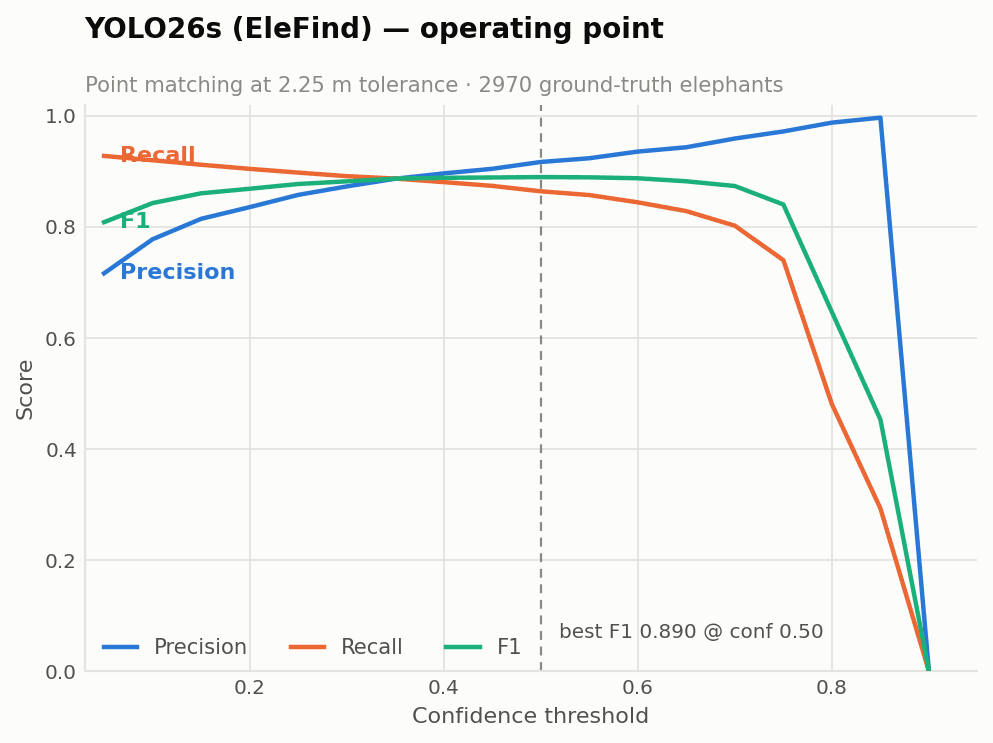
- Best-F1 confidence
- 0.50
- Cross-tile post-process
- NMS / IOU
- Post-process threshold
- 0.40
- RTX 3060 · 20 MP
- ≈3.2 s
- CPU · 20 MP
- ≈14.4 s
Evaluation figures
What the model learned
Model comparison
YOLO11s baseline vs YOLO26s
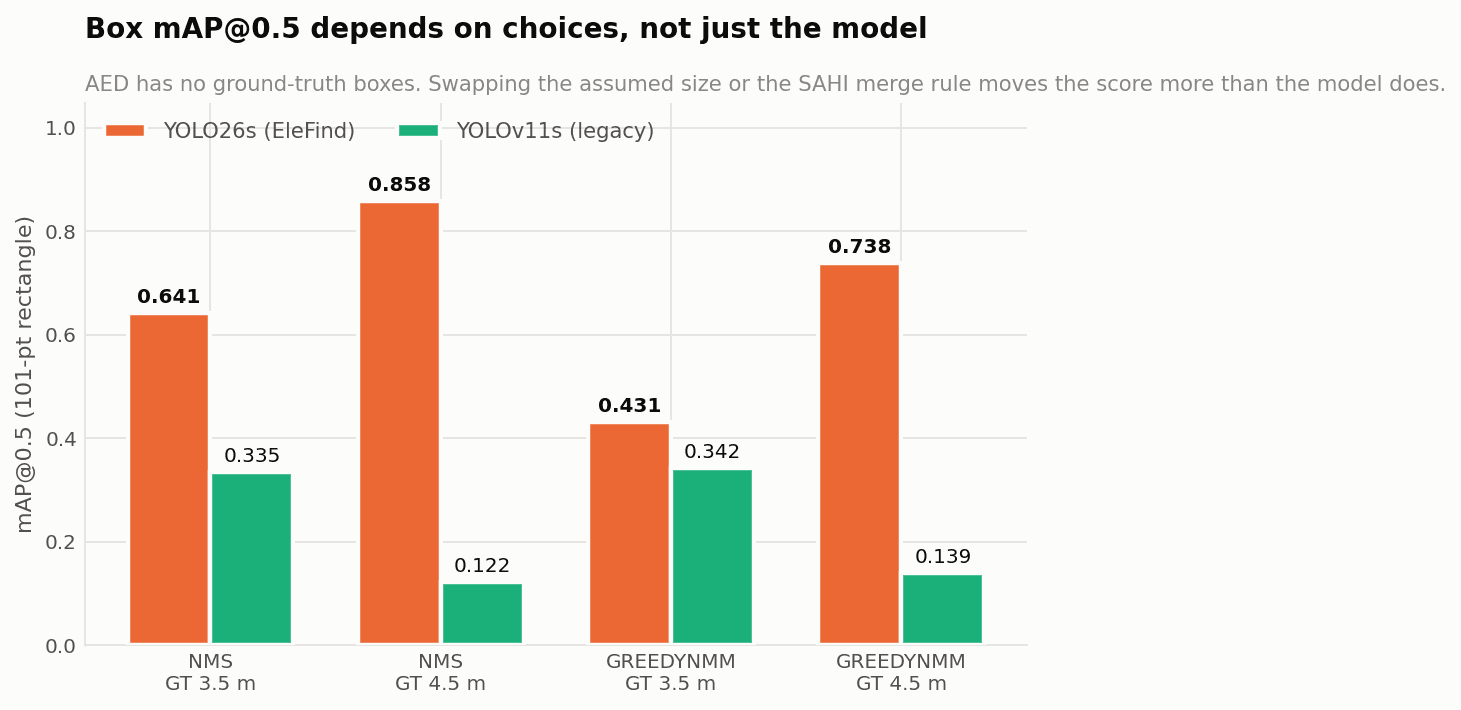
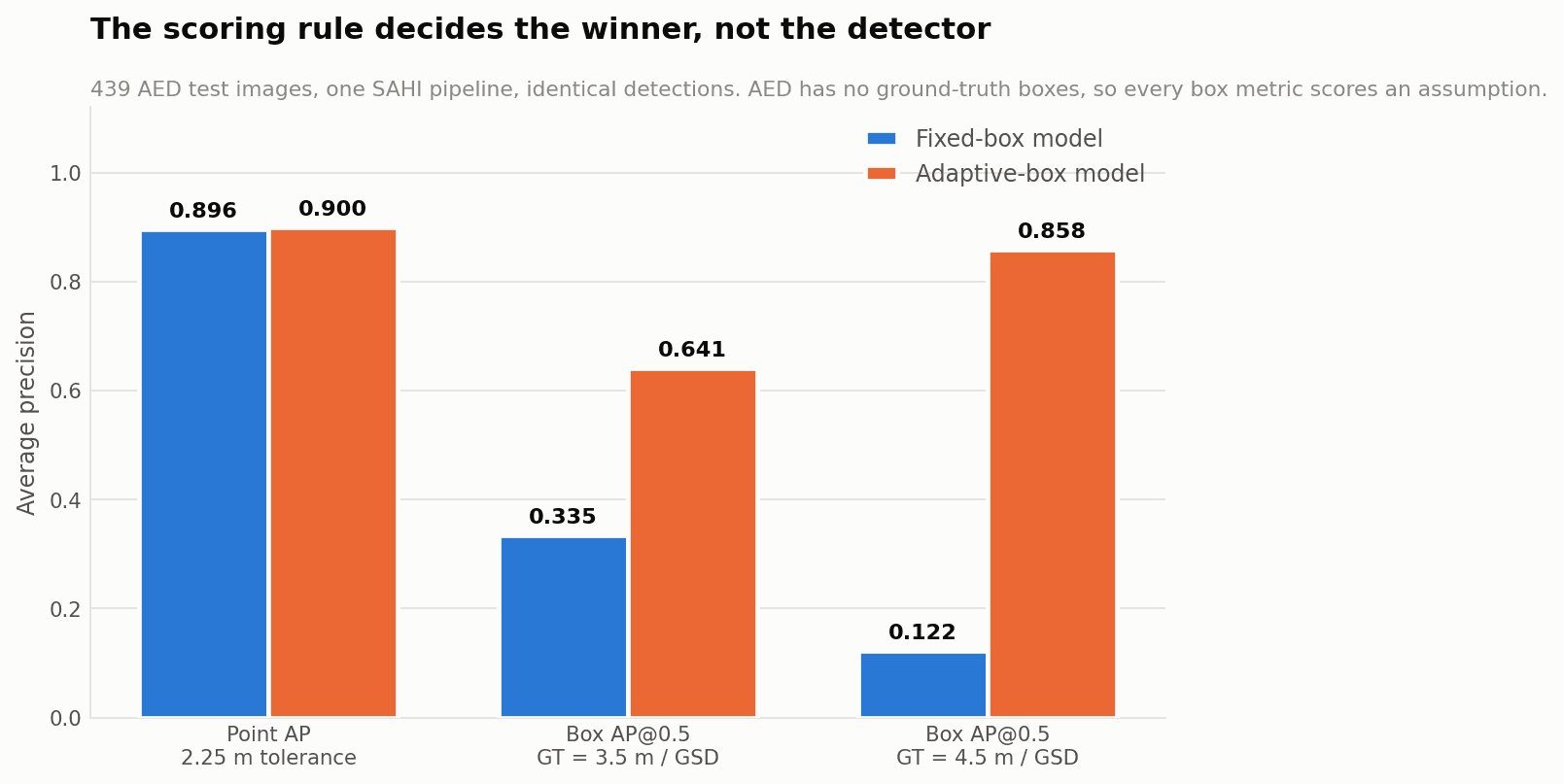
Both models below were evaluated on the same held-out source photographs using the same tiled pipeline and metre-based matching. YOLO26s makes a modest point-metric gain, while its adaptive predicted boxes produce a much stronger result under the 4.5 m synthetic-box convention.
Known limits
- Tiled inference is required for full-resolution survey photographs.
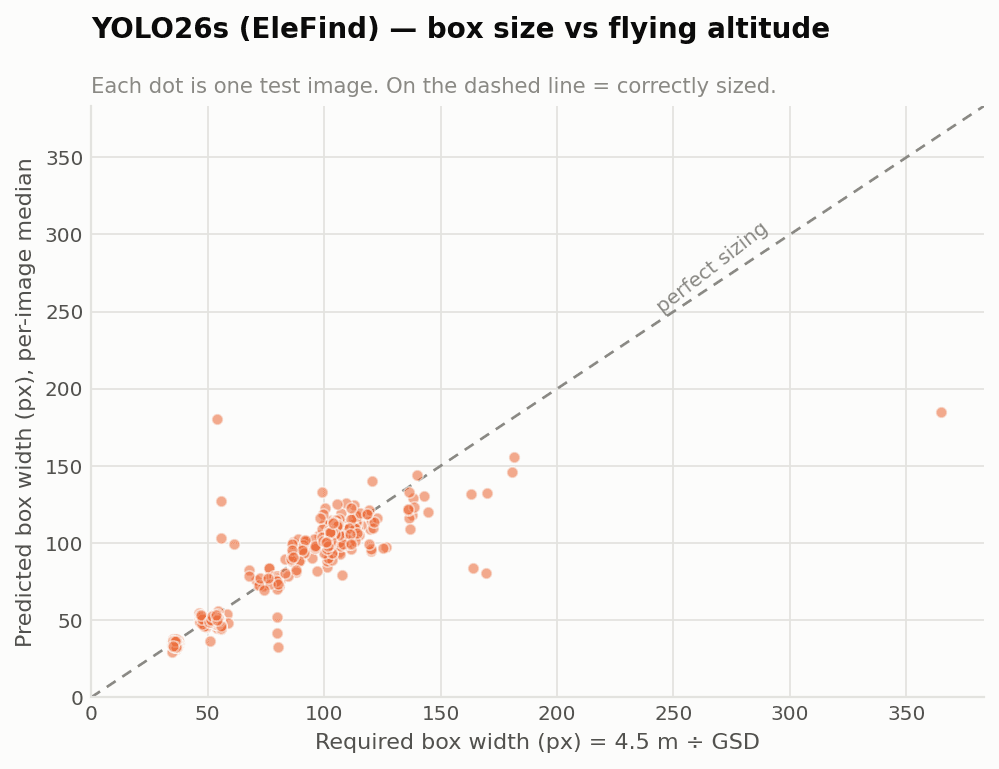
- The evaluated altitude range corresponds to 0.024–0.130 m per pixel.
- Domain shift beyond aerial savanna and bushland can reduce performance.
- Outputs require human verification before census or enforcement use.